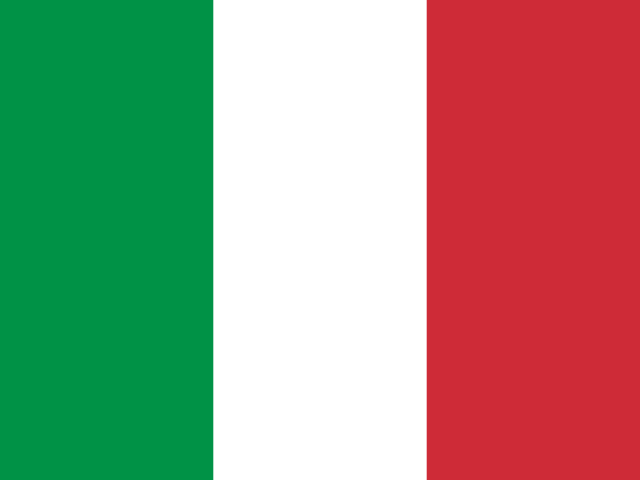
 Complete Guide for 2026
Working in Italy
Italy offers a unique blend of rich cultural heritage, excellent quality of life, and growing economic opportunities. While salaries may be lower than Northern Europe, the lower cost of living, especially outside major cities, provides good purchasing power. Italy's economy is strong in manufacturing, fashion, design, tourism, and increasingly in technology, particularly in Milan and Rome.
Salary Statistics in Italy
Understanding salary ranges helps you negotiate better and set realistic expectations
Average Salary
€33,000
per year
Median Salary
€28,000
per year
Minimum Wage
N/A
per year
Top 10% Earn
€65,000+
per year
Salary Distribution
Work Culture in Italy
Italian work culture values relationships and personal connections. Building trust takes time but leads to loyal professional partnerships. Lunch breaks are often longer and seen as important social time. While hierarchy exists, there's warmth in workplace interactions. The pace can be slower than Northern Europe, but quality and craftsmanship are highly valued.
Work Conditions
What to expect from employment benefits and legal requirements
Work Week
40 hours
Standard working hours
Annual Leave
20-26 days (varies by contract)
Paid vacation days
Public Holidays
12 days
National holidays per year
Sick Leave
Up to 180 days at 50-100% salary
Paid sick leave coverage
Maternity Leave
5 months at 80% salary
Paid leave for mothers
Paternity Leave
10 days at 100% salary
Paid leave for fathers
Work Conditions Overview
Pros & Cons for Expats
What international workers should consider before relocating
Advantages
Quality of Life
Excellent food, culture, climate, and work-life balance with emphasis on enjoying life.
Lower Cost of Living
Outside Milan, living costs are significantly lower than Northern Europe.
Strong Worker Protections
Robust labor laws, generous leave, and mandatory severance fund (TFR).
Cultural Experience
World-class art, history, cuisine, and lifestyle opportunities.
Healthcare
Universal healthcare system ranked among the best in the world.
Challenges
Lower Salaries
Wages are generally lower than Northern Europe, especially in tech.
Bureaucracy
Complex administrative processes and paperwork can be frustrating.
Language Barrier
English proficiency in workplaces varies; Italian is often necessary.
Economic Uncertainty
Higher unemployment rates, especially for youth, and slower economic growth.
Regional Disparities
Significant economic gap between North and South Italy.
Tax System Highlights
Key things to know about taxation in Italy
- Progressive IRPEF tax with 3 brackets: 23%, 33%, 43%
- Regional tax (1.23%-3.33%) and municipal tax (0%-0.9%) on top of national tax
- Social security contribution around 9.19% for employees
- Mandatory 13th month salary (Tredicesima)
- TFR severance fund accrual of ~6.91% per year
- Flat tax regime available for new residents (Impatriati regime)
Popular Cities for Expats
Top destinations for international professionals in Italy
Frequently Asked Questions
Compare Italy with Other Countries
See how Italy stacks up against other European countries for salaries, taxes, and work-life balance
vs
Italy vs Netherlands
Compare salaries, taxes & work conditions
vs
Italy vs Germany
Compare salaries, taxes & work conditions
vs
Italy vs France
Compare salaries, taxes & work conditions
vs
Italy vs Spain
Compare salaries, taxes & work conditions
vs
Italy vs Belgium
Compare salaries, taxes & work conditions
vs
Italy vs Austria
Compare salaries, taxes & work conditions
vs
Italy vs Poland
Compare salaries, taxes & work conditions
vs
Italy vs Switzerland
Compare salaries, taxes & work conditions
vs
Italy vs Denmark
Compare salaries, taxes & work conditions
vs
Italy vs Sweden
Compare salaries, taxes & work conditions
vs
Italy vs Norway
Compare salaries, taxes & work conditions
vs
Italy vs Finland
Compare salaries, taxes & work conditions
vs
Italy vs Ireland
Compare salaries, taxes & work conditions
vs
Italy vs Portugal
Compare salaries, taxes & work conditions
vs
Italy vs Greece
Compare salaries, taxes & work conditions
Ready to Calculate Your Salary?
Use our free calculator to see exactly how much you'll take home after taxes and deductions in Italy.
Open Salary Calculator